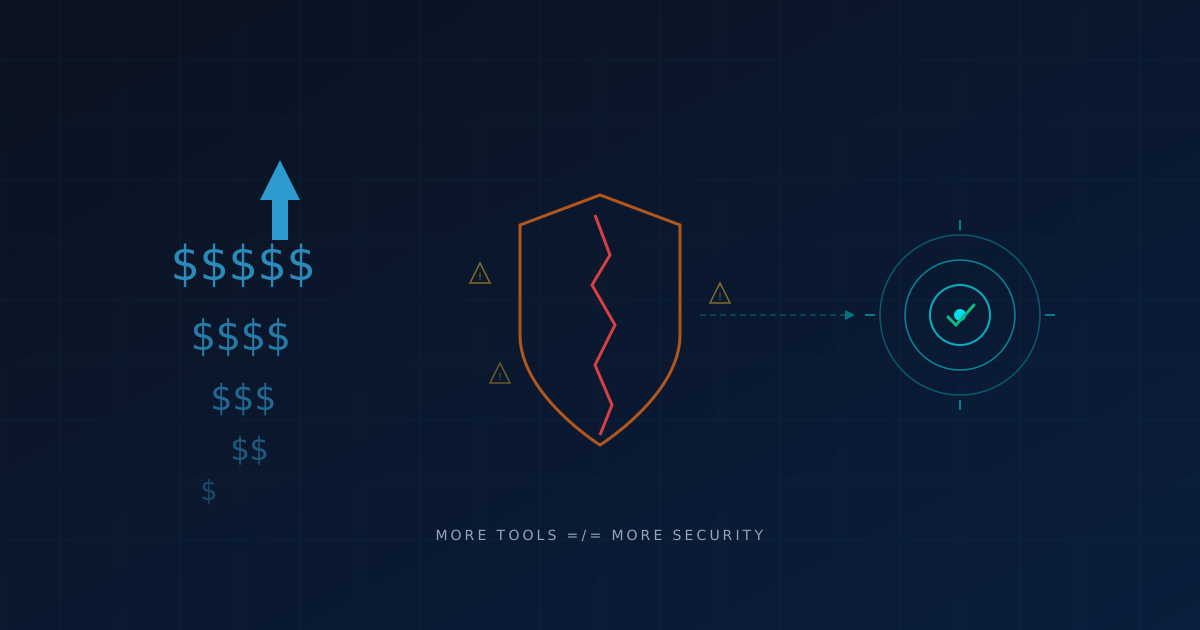
Global cybersecurity spending reached $213 billion in 2025. Breaches are at an all-time high. The average enterprise runs 45 security tools. And organizations with the most tools perform measurably worse at detecting and responding to threats.
This is the cybersecurity paradox: the counterintuitive reality that adding more security tools and spending more money on cybersecurity can make an organization less secure, not more.
Understanding this paradox is critical for any organization that wants to spend its security budget on outcomes rather than theater.
Defining the cybersecurity paradox
The term describes the pattern where increased investment in cybersecurity infrastructure fails to produce proportionally better security outcomes and, beyond a threshold, actively degrades them.
The theoretical foundation comes from Bruce Schneier, one of the most cited voices in information security and a fellow at Harvard Kennedy School. In 1999, he wrote: "The worst enemy of security is complexity." He elaborated: "You can't secure what you don't understand" and "More complexity means more people involved, more parts, more interactions, more mistakes in the design and development process, more of everything where hidden insecurities can be found."
In 2025, Schneier co-authored a guest editorial in MIS Quarterly (a top-tier information systems research journal) with Anthony Vance of Virginia Tech, formally applying this complexity principle to organizational cybersecurity research. Their paper, "Complexity Is the Worst Enemy of Security", establishes the theoretical foundation for why tool sprawl undermines security at the organizational level.
The economics were mapped even earlier by Ross Anderson at the University of Cambridge. In his seminal 2001 paper "Why Information Security is Hard — An Economic Perspective", Anderson showed that information insecurity is driven by perverse incentives: moral hazard, adverse selection, and liability dumping. His later work with Tyler Moore, published in Science, demonstrated that security investment patterns diverge from security outcomes for structural economic reasons, not just technical ones.
The numbers tell the story
The gap between cybersecurity spending and cybersecurity outcomes is widening, not narrowing.
Spending keeps rising:
- Global cybersecurity spending reached $213 billion in 2025, up from ~$150 billion in 2021 (Gartner)
- IDC projects the market will reach $377 billion by 2028
- Year-over-year growth has been sustained at 11-15%
Breaches keep getting worse:
- The average cost of a data breach hit $4.88 million in 2024, up 10% from 2023 — the largest spike since the pandemic (IBM/Ponemon)
- Breach frequency increased 75% year-over-year in 2024
- 61% of organizations experienced a breach in the past two years, despite a 59% increase in cybersecurity budgets
If buying more tools solved the problem, the problem would be solved by now.
How more tools make you less secure
The paradox is not a single failure. It is the compounding effect of several interconnected mechanisms, each supported by empirical research.
1. Tool sprawl fragments detection
The average enterprise runs 45 cybersecurity tools (Gartner, 2025). Nearly 30% of organizations run more than 50.
A landmark study by the Ponemon Institute and IBM found that organizations with 50 or more security tools rank 8% lower in threat detection and 7% lower in attack response capability compared to those with fewer tools. More tools, worse outcomes.
Each tool brings its own data formats, APIs, dashboards, update cycles, and configuration requirements. The integration burden grows combinatorially. Gaps between tools create blind spots, and attackers exploit the seams.
2. Alert fatigue buries real threats
Overlapping tools generate overlapping alerts. SOC teams receive an average of 11,000 alerts per day (Forrester), and false positive rates frequently exceed 50%, with some environments reaching 80%.
The human cost is measured and severe:
- 70% of SOC teams report being emotionally overwhelmed by alert volume (Trend Micro/Sapio, 2021)
- 43% of analysts occasionally or frequently turn off alerts; 40% ignore incoming alerts entirely
- Organizations leave 27-30% of all alerts uninvestigated (IDC)
Real threats are not missed because organizations lack detection capability. They are missed because too much detection generates too much noise.
3. Misconfiguration multiplies attack surface
More tools means more configuration surfaces, each of which can be misconfigured. Gartner estimates that 99% of firewall breaches are caused by misconfigurations. According to the Verizon DBIR 2023, 74% of all breaches include a human element: error, privilege misuse, or social engineering.
Security tools themselves become attack vectors. They typically require privileged access, making them high-value targets. Supply chain attacks on security vendors (SolarWinds, Codecov, and others) demonstrate that security infrastructure can be weaponized against the organizations it is meant to protect.
4. Compliance theater replaces real security
Purchasing a tool often substitutes for testing whether that tool is effective. 53% of IT security leaders don't know if their cybersecurity tools are actually working, despite an average annual spend of $18.4 million (Ponemon/AttackIQ, 2019).
The act of buying security creates organizational complacency. "We have the tool, so we're covered." But having a firewall is not the same as having a properly configured firewall. Having an EDR agent installed is not the same as having one that detects lateral movement. There is a fundamental difference between owning a control and verifying that it works.
5. Resource dilution and staffing strain
Every tool requires people to deploy, configure, update, monitor, and maintain. The cybersecurity talent shortage is well documented: organizations with severe staffing shortages pay $1.76 million more per breach on average (IBM, 2024), and staffing shortages increased 26% year-over-year.
Spreading a finite workforce across 45+ tools means less expertise per tool, more context-switching, and slower response when it matters most.
The industry is starting to recognize the problem
The trend toward vendor consolidation confirms that the industry itself sees the paradox at work:
- 75% of organizations are actively pursuing security vendor consolidation, up from 29% in 2020 (Gartner, 2022)
- 65% consolidate to improve risk posture, not to reduce cost
NIST's Risk Management Framework (SP 800-37 Rev. 2) explicitly calls for "managing complexity of systems through consolidation, optimization, and standardization" to "reduce the attack surface and technology footprint exploitable by adversaries." CISA's Cross-Sector Cybersecurity Performance Goals 2.0, released in December 2025, address the same principle by consolidating IT and OT goals to eliminate silos and reduce implementation complexity.
Consolidation is one response. But it only reduces the number of defensive tools. It does not address a more fundamental question: do you actually know what an attacker can do to your systems?
Offensive security breaks the cycle
Offensive security, particularly penetration testing, operates on fundamentally different principles than the defensive tool stack. It does not add to the complexity problem. Instead, it cuts through it.
Here is why:
It tests outcomes, not configurations. A pentest does not ask "is this tool installed?" or "is this policy compliant?" It asks: "can an attacker get in, and how far can they go?" This is the only question that matters, and it is the question that no amount of defensive tooling can answer about itself.
It provides ground truth. Defensive tools generate alerts about possible threats. A pentest produces evidence of actual exploitable vulnerabilities. There is no false positive in a successful exploitation: the proof-of-concept either works or it doesn't. This gives security teams something rare in cybersecurity: certainty.
It cuts through tool sprawl. It does not matter how many tools sit between the attacker and the target. A pentest evaluates the entire defensive stack as a system. If 44 tools are configured correctly and one has a misconfiguration that allows access, the pentest finds it. No defensive tool can assess its own blind spots.
It eliminates the false sense of security. This is perhaps the most important function. Organizations that pentest regularly cannot maintain the illusion that their defenses are working simply because they bought them. A pentest replaces assumptions with evidence.
It creates actionable priorities. A pentest report does not say "you have 11,000 alerts to review." It says "here are the three things an attacker would actually exploit, in order of severity, with proof." This is the kind of signal that security teams can act on immediately, without alert fatigue, without guessing which findings are real.
It reduces, rather than adds, complexity. A pentest consumes no ongoing operational overhead. It does not require permanent integration into the tool stack, does not generate a daily stream of alerts, and does not add another dashboard to monitor. It is a focused, time-bounded assessment that produces a clear output.
The economic logic
Ross Anderson's security economics framework explains why offensive security avoids the paradox's traps:
- No moral hazard: A pentest cannot make you complacent because its entire purpose is to show you where your defenses fail
- No adverse selection: You know immediately whether a pentest was effective because the findings are empirically verifiable
- No liability dumping: A pentest vendor cannot hide behind "the tool was deployed correctly." The output is a list of what was actually exploited
Defensive tools suffer from all three of these economic distortions. Pentesting is structurally resistant to them.
What good offensive security looks like
Not all pentesting is equally valuable. A pentest that is only performed annually, takes weeks to schedule, and delivers a report full of scanner output relabeled as "findings" does not break the paradox. It becomes part of the compliance theater.
Effective offensive security should be:
- Frequent: Security posture changes with every deployment. Annual testing leaves 364 days of uncertainty
- Fast: If a pentest takes two weeks to schedule and a week to execute, the development team has already shipped new code by the time findings arrive
- Thorough: Coverage across all major vulnerability classes, not just the ones a particular tester happens to know well
- Verified: Every finding backed by a working proof-of-concept, not a theoretical risk score
- Actionable: Clear remediation guidance that developers can implement, not a 200-page PDF that sits in a drawer
These requirements are increasingly difficult for traditional manual pentesting to meet at scale, which is one reason autonomous pentesting is gaining traction. As a reference point, autonomous systems have demonstrated strong exploitation capability across a wide range of vulnerability classes. For example, in the XBEN CTF benchmark suite, autonomous pentesting achieved an 87.5% success rate (91 of 104 flags), exceeding the best reported human score of 85%, with 100% success in classes like SQL injection, IDOR, SSRF, and business logic vulnerabilities.
The bottom line
The cybersecurity paradox is not a theoretical curiosity. It is an empirically documented pattern in which the dominant industry approach, which is to buy more defensive tools, produces diminishing and eventually negative returns on security.
Offensive security through pentesting operates outside this pattern. It does not add complexity, it tests the complexity you already have. It does not generate more noise, it produces signal. It does not create a false sense of security, it replaces assumptions with evidence.
If your organization is spending more on cybersecurity every year and still unsure whether your defenses actually work, the answer is not another tool. The answer is to test what you have.
Sources and further reading:
- Schneier, B. & Vance, A. (2025). "Complexity Is the Worst Enemy of Security." MIS Quarterly, 49(1), 205-210.
- Anderson, R. (2001). "Why Information Security is Hard — An Economic Perspective." ACSAC 2001.
- Anderson, R. & Moore, T. (2006). "The Economics of Information Security." Science, 314(5799), 610-613.
- IBM / Ponemon Institute. Cost of a Data Breach Report 2024.
- IBM / Ponemon Institute. Cyber Resilient Organization Report 2020.
- Gartner. Global Cybersecurity Spending Forecast 2025.
- Gartner. Security Vendor Consolidation Survey 2022.
- NIST. SP 800-37 Rev. 2: Risk Management Framework.